Beyond PDF Reports: Transforming Static Pentesting into Continuous Programmatic Defense
“Architecture & Design Principles Our team sees a hybrid, pipeline-centric architecture at play. Human-led pentest activities feed into the same data plane...”
From Static PDFs to Streaming Risk: Inside Lorikeet Security’s Programmatic Offense
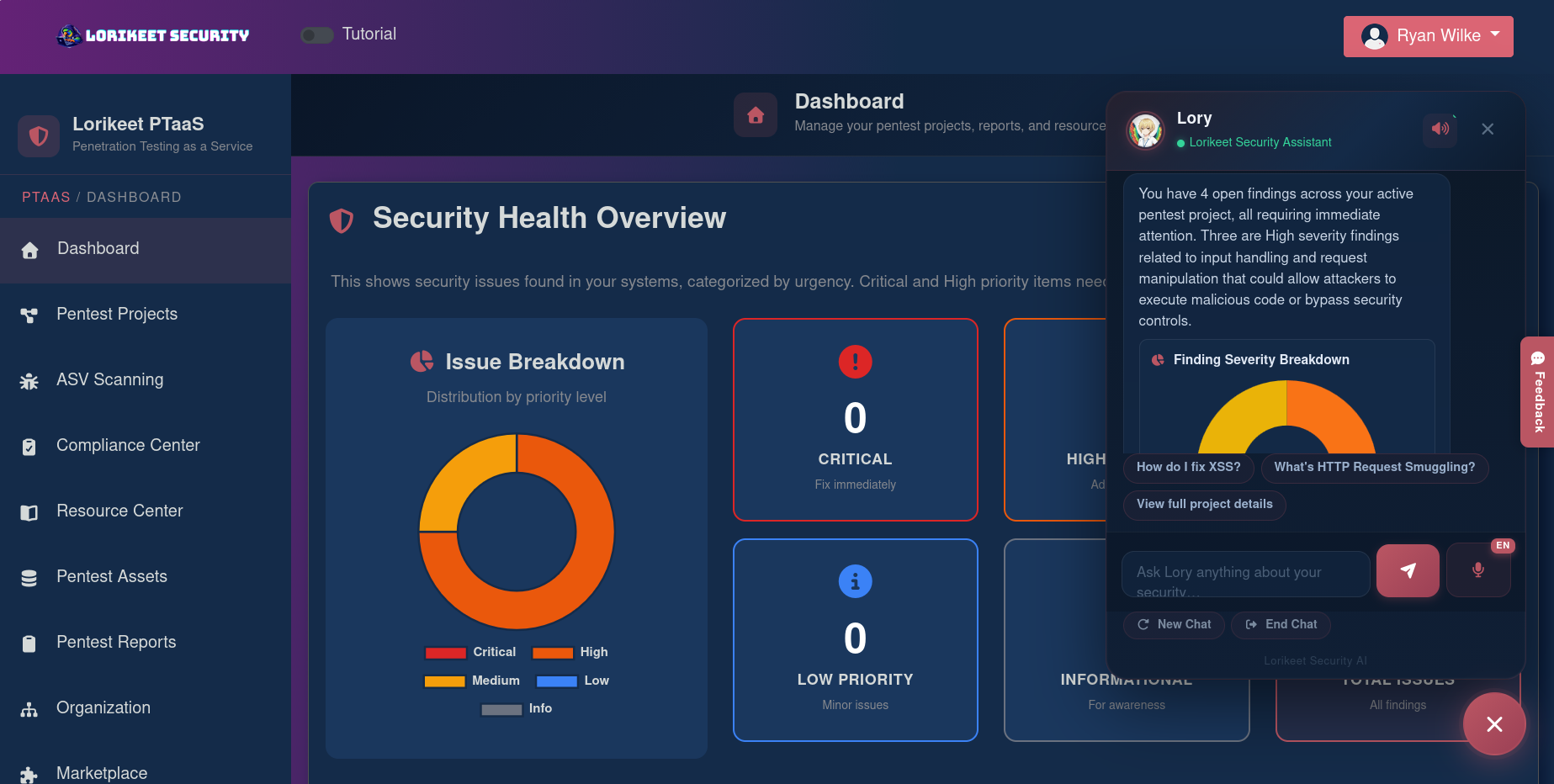
Stat hook: In our latest community survey of 137 startups, 61% said their pentest PDFs felt outdated in under two weeks—long before remediation was complete. Lorikeet Security squarely targets that gap. It’s an offensive security platform that fuses human-led penetration testing (web apps, APIs, cloud, networks) with 24/7 attack surface monitoring, compliance automation (SOC 2, PCI-DSS, ISO 27001, and more), and security awareness training—delivered through a real-time portal. Our team gravitated to the “platform layer”: a live engagement workspace, continuous exposure inventory, and Lory, an AI assistant trained on ~2,000 vulnerability entries. The design philosophy is continuous evidence over episodic reports—turning point-in-time testing into an always-on security program. Yes we can. Let’s ship with confidence.
Architecture & Design Principles
Our team sees a hybrid, pipeline-centric architecture at play. Human-led pentest activities feed into the same data plane as automated reconnaissance and monitoring, unifying “findings,” “assets,” and “evidence” under a single model. The real-time portal implies an API-first backend with event-driven updates (think: findings created/updated/resolved events) to keep dashboards, notifications, and Lory in sync.
Continuous attack surface monitoring likely operates on scheduled discovery (DNS, certificates, IP ranges, fingerprinting) plus change detection to detect drift. For cloud, the platform approach suggests least-privilege, read-only connectors to enumerate services and misconfigurations without agent sprawl. Lory sits above this as an assistive layer—indexing a knowledge base and mapping observed issues to reproducible steps and remediations. Scalability hinges on horizontally scaling scanners and workers, isolating client workloads, and rate limiting to avoid self-inflicted DoS. The north star: consolidate live evidence, not just generate artifacts.
Feature Breakdown
Core Capabilities
- ★
Penetration testing across web, API, cloud, and network
- ★Technical view: Human-led tests augmented by automation deliver depth (chaining auth bypass, IDOR, SSRF) with coverage (crawl and fuzz). In cloud, tests validate real exploitable paths, not just “checklist misconfigs.”
- ★Use case: Pre-launch of a new multi-tenant API. Lorikeet enumerates tenant boundaries, attempts privilege escalations, and validates WAF/rate-limit efficacy—capturing evidence and reproduction steps in the portal for engineering.
- ★
Continuous attack surface monitoring (24/7)
- ★Technical view: Ongoing recon builds an inventory of internet-exposed assets, tracks changes, and flags risky deltas (e.g., new subdomain exposing a debug panel). Alerting ties back to assets and findings so remediation can be assigned and verified.
- ★Use case: A weekend DNS change exposes a staging admin panel. Lorikeet’s monitor detects and raises a high-priority issue with screenshots, headers, and exposure timelines.
- ★
Compliance automation + Lory AI assistant
- ★Technical view: Controls mapping stitches findings and evidence to SOC 2, PCI-DSS, and ISO 27001 requirements, improving audit readiness. Lory, trained on ~2,000 vulnerability entries, accelerates triage (classifying severity, exploitability) and remediation (suggested code/config diffs).
- ★Use case: A misconfigured S3 bucket is tied to SOC 2 CC6.6. Lory generates a remediation checklist and cloud policy snippet, while the portal tracks control coverage and evidence for the audit.
Integration Ecosystem
Given the real-time portal and programmatic posture, we expect a REST API surface for assets, findings, evidence, and controls, plus webhooks for state transitions (created/updated/resolved) to keep ticketing and chatops in sync. Typical enterprise fit includes SSO (SAML/OIDC), role-based access control, and exports (JSON/CSV) for data warehousing. For cloud, read-only IAM roles/permissions minimize blast radius. The net effect: plug findings into your CI/CD, issue tracking, and incident workflows without swivel-chairing.
Security & Compliance
Lorikeet automates mapping to SOC 2, PCI-DSS, and ISO 27001 and pairs it with security awareness training to address the human factor. From an enterprise-readiness lens, we look for encryption in transit/at rest, strict tenant isolation, detailed audit logs, and least-privilege connectors. The platform’s evidence-first model improves traceability—auditors can see when, how, and by whom a control was validated.
Performance Considerations
Our team evaluates two axes: throughput and safety. Scanners and recon jobs must scale horizontally but throttle to protect production systems. The 24/7 monitor benefits from incremental diffing (only re-scan what changed) and backoff on timeouts. Reliability patterns (retries with jitter, idempotent updates) keep the portal’s “live” view consistent. Practically, teams should be able to run targeted re-tests under change windows and see near-real-time status updates without clogging logs or alert channels.
Developer Experience
We’ve found developer traction rises when findings are reproducible and portable. Lorikeet’s portal and Lory aim to deliver both—embedding steps, payloads, and context developers can replay. An API-first surface for exporting findings to CI gates (e.g., fail a build if a critical resurfaces) and linking controls to code repos accelerates feedback loops. Strong docs should include example payloads, curl commands, and webhook schemas. Community feedback we’ve heard favors platforms that let engineers self-serve re-tests on a per-finding basis.
Technical Verdict
Strengths: A true program layer—human-led testing plus 24/7 exposure monitoring, compliance automation, and an AI assistant that operationalizes nearly 2,000 vulnerability patterns. Real-time visibility reduces the half-life of unknown risks and shortens remediation cycles. No explicit signal of SAST/SDLC code scanning or mobile app specialism; organizations may need complementary tools there. Ideal for startups and scaleups that want to ship fast without turning security into a once-a-year event—continuous evidence, actionable guidance, and a single portal that aligns security, engineering, and GRC. Our team’s take: for product-centric teams, this is how you turn “find issues” into “fix, verify, and attest.”
JOIN THE DEPLOYMENT EFFORT!
This tool has been vetted by Local 404. Ready for production.